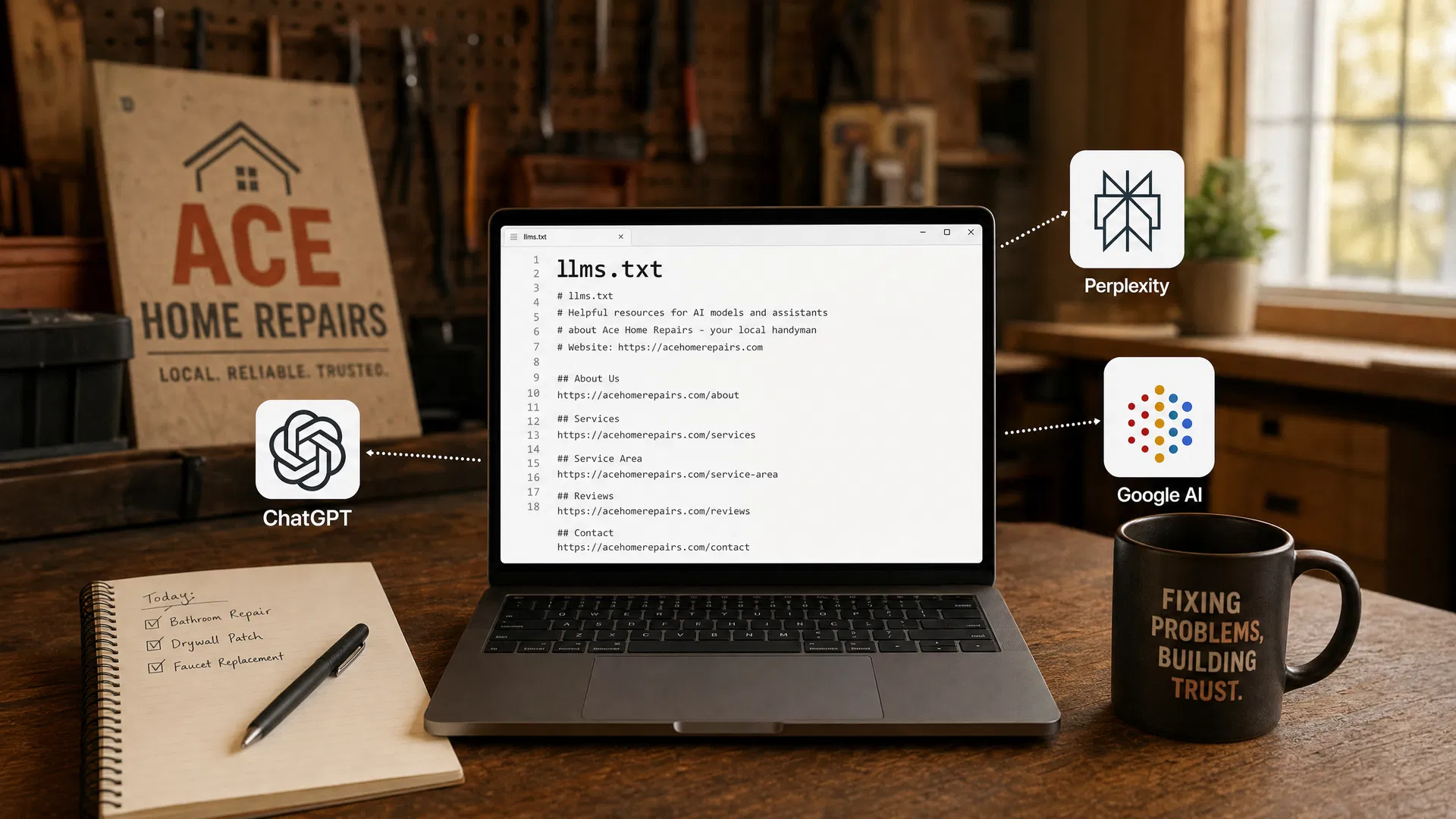
What Is llms.txt and Why Does Your Local Business Website Need One?
If you have ever wondered how ChatGPT or Perplexity decides which businesses to recommend, part of the answer is surprisingly simple: they read your website. But reading a full website — with its navigation menus, JavaScript, images, and marketing copy — is slow and imprecise. That is where llms.txt comes in.
The Short Answer
llms.txt is a plain-text file that lives at the root of your website — at yourdomain.com/llms.txt — and gives AI assistants a clean, structured summary of your business. No HTML. No JavaScript. No images. Just the facts, written in a format that AI systems can read in under a second.
Think of it as the AI equivalent of a business card. Your full website is your showroom. llms.txt is the card you hand to someone who needs the key facts immediately.
Does a Plumber Need to Know What llms.txt Is?
No. A plumber does not need to understand the technical details any more than they need to understand how Google's crawling algorithm works. What they need to know is this: their website either has it or it does not, and the ones that have it give AI assistants a faster, more accurate picture of their business.
The same way a plumber does not need to write their own JSON-LD schema — they just need a website that includes it — they do not need to write their own llms.txt. It is a technical deliverable, not a client task. FOUNRA includes it in every build.
What Goes Inside llms.txt?
A well-written llms.txt file contains the information an AI assistant needs to confidently recommend your business:
Who you are. Your business name, what you do, and where you operate. One clear paragraph, no marketing fluff.
Your services. A plain-language list of what you offer — not "comprehensive plumbing solutions" but "emergency call-outs, boiler installation, leak repair, bathroom fitting, drain unblocking."
Your location and service area. The specific towns, cities, or postcodes you cover. This is critical for local recommendations.
Your pricing. Even a rough range helps AI systems give accurate answers when someone asks "how much does a plumber cost in [city]?"
Your key pages. Direct links to your services page, contact page, and any other pages an AI might want to cite.
FAQs. The questions your customers actually ask, answered plainly.
Why It Matters More Than You Might Think
AI assistants are increasingly the first stop for local service searches. Someone types "best plumber in Manchester" into ChatGPT or asks their phone's AI assistant for a recommendation. The AI does not show a list of links — it names a business.
To name your business confidently, the AI needs to be certain about three things: what you do, where you do it, and that you are a real, active business. llms.txt answers all three in under a second.
Without it, the AI has to piece together that information from your homepage copy, your contact page, your Google Business Profile, and whatever other sources it can find. That process introduces uncertainty. Uncertainty means the AI is less likely to recommend you and more likely to recommend a competitor whose information is clearer.
How It Fits With Everything Else
llms.txt is not a replacement for JSON-LD schema, a Google Business Profile, or fast page speeds. It works alongside all of them. Think of it as a shortcut that AI systems can take when they want a quick, reliable summary — while the rest of your site's technical infrastructure handles the deeper signals.
The analogy is a well-organised filing cabinet. JSON-LD schema is the labels on every folder. Your Google Business Profile is the external directory listing. llms.txt is the one-page summary on top of the cabinet that tells anyone who opens the drawer exactly what is inside.
The Standard Is New — Which Means Acting Now Has an Advantage
The llms.txt standard was proposed in 2024 and is still being adopted. Most local business websites do not have one. That means adding it now puts you ahead of competitors who are waiting to see if it catches on.
AI platforms are actively looking for cleaner ways to ingest business information. llms.txt is one of the clearest signals you can send that your site is built for the way AI search works — not the way Google search worked in 2015.
What FOUNRA Does
Every website FOUNRA builds includes a llms.txt file written specifically for that business — their services, their location, their pricing, their key pages. It is updated whenever the business information changes, just like the JSON-LD schema and the rest of the site's technical infrastructure.
If your current website does not have one, it is one of the fastest additions to make. If you are starting from scratch, it is included as standard.
Frequently Asked Questions
Does llms.txt replace my website? No. It is a supplement — a fast-access summary for AI crawlers. Your full website still matters for human visitors, Google indexing, and the deeper AI signals that come from structured content.
Will ChatGPT actually read my llms.txt? Major AI platforms including ChatGPT, Perplexity, Claude, and others are adopting the standard. Perplexity in particular has been an early adopter. As the standard matures, support will only increase.
How often does it need to be updated? Whenever your business information changes — new services, new service area, updated pricing. FOUNRA handles this as part of the ongoing maintenance plan.
Is it hard to create? For a developer, no — it is a plain text file. For a business owner without technical knowledge, the challenge is knowing what to include and how to structure it for AI readability. That is why FOUNRA writes it as part of the build, not as an afterthought.